
If you are buying an investment property in Valencia, one decision shapes everything else:
will you rent it long-term to a resident, or short-term to visitors? The answer affects your net
return, how much work the property takes, how easy it is to sell later and, increasingly,
whether the property can legally be used the way you plan.
Here is how the two strategies compare in practice, based on what we see every day selling
investment property in Valencia to buyers from across Europe.
Residential rentals: stable income, strong tenant protection
With a long-term rental you sign a contract with a tenant who lives in the property, and you
receive a fixed monthly rent. Once a good tenant is in place, the property needs little day-to-
day attention, and your income is easy to forecast.
What many foreign investors underestimate is how strongly Spanish law protects tenants.
Under the Urban Leases Act (LAU), a tenant can extend the contract up to 5 years if the
landlord is a private individual, or 7 years if the landlord is a company, while the tenant can
leave after 6 months. Annual rent increases are limited, and recovering a property from a
tenant who stops paying can take months. Tenant screening, a solid contract and rent-
default insurance are not optional extras; they are part of the investment.
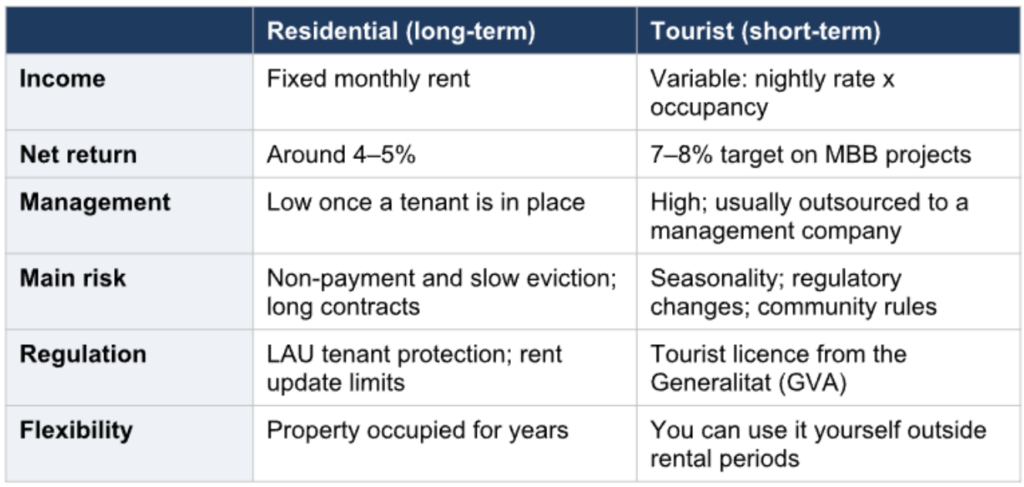
In Valencia, a long-term rental typically delivers a net return of around 4–5%.
Tourist rentals: higher potential return, more management
With a tourist rental, income depends on nightly rates and occupancy. Valencia has year-
round demand thanks to its climate, beach, events and growing international flight
connections, but income still varies by season.
The return can be significantly higher. Based on our own projects, a well-located licensed
tourist apartment should target a 7–8% net return (after operating costs, before taxes). That
return comes with more moving parts: cleaning, check-ins, guest communication, pricing,
platform commissions and a professional management company, which usually takes a
percentage of revenue.
Side-by-side comparison
Look at net return, not gross income
A property that earns more per month is not automatically the better investment. Before
comparing, add up every cost:
- Purchase costs for a residential home: transfer tax of 10% on resale homes in the
Valencian Community, or 10% VAT plus stamp duty on new builds, plus notary, land
registry and legal fees. - Purchase costs for a tourist property: licensed tourist apartments are generally taxed
at 21% VAT, plus notary, land registry and legal fees. Buyers purchasing as a
company or self-employed professional may, in some cases, be able to apply the
reverse-charge mechanism (inversión del sujeto pasivo), so the VAT is not paid
upfront in cash, and the VAT is then offset as the property is rented out with VAT.
This option is not available to private individuals, so the right purchase structure
should be decided before signing. - Running costs: community fees, IBI property tax, insurance and maintenance.
- For tourist rentals: management fee, cleaning, laundry, utilities, platform
commissions, furnishing and replacing items. - Empty periods: weeks without guests, or months between tenants.
- Income tax: non-resident owners pay tax in Spain on rental income. Your tax adviser
will tell you which rate and deductions apply to you.
When we present a property to an investor, we always start from the estimated net return,
because that is the number that matters.
Tourist rentals in Valencia: the licence is the scarce asset
This is where the decision really gets made. Valencia has adopted one of the strictest
tourist-rental frameworks in Spain:
- Under the city rules approved in March 2026, new tourist apartments in residential
buildings are only allowed on ground and first floors, with their own street entrance
and without sharing a landing with homes. - Neighbourhood caps apply: tourist places cannot exceed 8% of the registered
population, tourist homes cannot exceed 2% of the housing stock, and tourist use of
ground-floor premises is capped at 15% of a block’s commercial premises. Where a
cap is reached, no new licences are granted. In practice, new openings are close to
impossible in much of the city. - Nationally, since 3 April 2025, a new tourist rental needs the approval of three-fifths
of the owners in the building’s community. - What you need to operate is the tourist licence issued by the Generalitat Valenciana
(GVA), registered in the regional tourism register. The national registration number
that was required to advertise on platforms has been annulled by the Spanish
Supreme Court, so it no longer applies.
The consequence for investors is simple: a property that already has a valid tourist licence
has become a scarce product, and scarcity supports both its income and its resale value. It
also means that buying a flat «to get a licence later» is, in most cases, no longer a realistic
plan.
Before buying any tourist property, always check that the licence is in force, correctly
registered, linked to that specific unit and that nothing in the community statutes prohibits the
activity.
So, which strategy should you choose?
A long-term rental is usually the better fit if you want predictable income with little
involvement, plan to hold for many years and prefer a simpler legal and tax position.
A tourist rental is usually the better fit if you are looking for a higher net return, want to use
the property yourself for part of the year, accept some seasonality and work with a
professional management company. In that case, only consider properties that already have
a valid licence.
How My Blue Bricks can help
My Blue Bricks specialises in investment property in Valencia and the Valencian Community
for international buyers. We sell ground-floor apartments with tourist licences, new-build
developments and resale homes, and we work with trusted partners for mortgages, NIE
applications and the right purchase structure. Take a look at our current projects, such as
Josep Saragossa and Puçol Playa.
Request a net-return comparison.
Tell us your budget and goals, and we will send you a
side-by-side breakdown of a licensed tourist property and a long-term rental option in
Valencia, with all costs included.
This article is for general information only and does not constitute legal, tax or financial advice.
Regulations may change; always check the current rules and consult a qualified adviser before
buying. Information updated: October 2026.
Discover My Blue Bricks Projects | Contact Us | Join Our Newsletter